Thursday, 17 November 2011

Amateur Photography, Professional Theory ... Mutations


This piece mixes intentionally low production amateur images - my own, some of which are already up here, with a text written for Mutations book of Paris Photo - It was terribly misprinted there, so here is the original with the images in place as paragraphs.
If only - a little dream of the photographic as beyond itself....
What if, in the end, after so many (arid) discussions around the digital and the virtual, with all their little tautologies, teleologies and often disproportionally ambitious philosophical implications for the image concerning indexicality or time, photography really was redundant? And what if the lens and the screen had finally merged and annihilated one another's specificity in the gaze; and all those millions of users of the little screen, holding them up, cameras and phones,  - but without a cloth hood to protect them from the ambient light - were otherwise no distance at all from the first photographers; so that now photography does not even have a history? And what if this redundancy were photography's only persisting resource, the single strength that it has to be a kind of gesture, or diverse set of gestural practices, with its own name, a denoted something? Still. Still photography.
Then I guess that this would be what photography has achieved, in its hypertrophic and destined consumerism, to become the measure of a certain freedom from any kind of history or history's burdens, a hiding place from which we might, should we so choose, take view on the world; just as Arago or Sadi Carnot or von Humboldt might once have wished right at the beginning, or the National Geographic Magazine or the school of the Bechers might have shown us; but from a viewpoint of such radical and redeeming disintegration that, at last, the seeing of this very point will be left to chance, to luck. It's lucky that it turned out like this.
To live in this being-set-aside (écartement) demands a certain passive courage or desire to lose; a letting go, as if redundancy takes with it the apparatus of a previous glory the superfetation of accompaniments, histories, theories. I think that I would want all of this and more:
to forget La chambre claire and Roland Barthes' melancholy over his mother's death, and to retain only some of his grammar, freed from the burden of the lost or hidden cliché;

only vaguely to recall that it once seemed urgent to decide how many degrees Walter Benjamin had or had not turned in the time between his Little History  and the essay on technical reproducibility; or to leaf through Aby Warburg's Mnemosyne Atlas as if it were a comic strip without a plot and so be lost in thought;
to fail to make any significant distinction between the elevated religiosity of an Andreas Serrano, that proceeds from an emulsification of Catholic belief with  transgression according to Georges Bataille, and a self-pic located as a sexual lure in some gay fetish site on the Internet;
to accept that those dreadful images of the camps arrive at signifiance not in the anxieties of theoretical hermeneutics, but at the point they migrate into the filmic practice of an Alain Resnais or the painting of a Bracha Ettinger.
to walk past the immense photographs that furnish the contemporary art museum throughout the world today wishing only that they could be smaller; and to accept that, if there were ever an optical unconscious, it could not be more than a camouflage for the infinity of singularities that is the human unconscious, and that, as a notion, it confounds one kind of gesture with this multiplicity of traces that are left and made before they have a form.
This, I believe, and it is a matter of belief, is not too far from something that Pierre Mac Orlan once had to say in his introduction to a little plaquette on Germaine Krull, published by the NRF in 1931:
'La médiation, même spontanée, devant certaines épreuves photographiques permet de créer d'autres images, des images 'cérébrales' comme disent désormais les petits maquereaux de la rue de Lappe.'
And this too, and if I give Mac Orlan so much space in my own words, it is because I have to choose some mid point in the histories that I want to lose to show that my idea, too, already has a life:
Un mélange de candeur héréditaire et de saloperie acquise patiemment au contact des hommes donne à ce témoin gênant, qu'est l'objectif photographique, un tel choix d'expériences et de conclusions, qu'un album de photographies de famille devient quelque chose de plus émouvant que la nature elle-même, car il devient le complice de l'homme.[i]

Of course all of this is yesterday's discourse, a redundant discourse of 'man'; but the subtle prosopopoeia of the lens, its 'patiently acquired' filth or muckiness takes it aside from an ordinary notation, and drifts into a prediction of the digital age; the time of photography's prosthetic redundancy that is but one, non-tragic outcome of the ending of its chemical history. It's a curious redundancy, because now to take a photograph is neither more nor less necessary that taking a piss.
At the same time, and perhaps for the first time in its history, the photographic arrives at an immense irony which I suggested at the outset: that the confluence of its obsolescence as a single technology with its redundancy as an authorial practice frees it perhaps to engage (perhaps only) in a distribution of the sensible itself in some sense free of the authorial function: or rather as Tacita Dean once said in an interview in October:
So obsolescence is about time in the way film is about time: historical time, allegorical time, analog time. I cannot be seduced by the seamlessness of digital time, like digital silence, it has a deadness. I like the time you hear passing (...). So obsolescence has an aura: the aura of redundancy and failure...[ii]
And the immensity of the irony is this, that it is this digital obsolescence itself that frees photography from digital time, to become a record of oppression or of resistance to it, from the outside the Bank of England to Tahrir Square. This freedom is a freedom from the eminently seamless time of redemption, a time for the redundant of world capitalism that is the truly human.


[i]  Germaine Krull par Pierre Mac Orlan, Photograhes Nouveau, Paris, 1931.
[ii] Cited from: Clara Schulmann, "A Rebours, The Film as Site:  The Kodak Ghost Ship, Tacita Dean's obsolescent practices", "Memory / Media / Power", joint doctoral seminar, Creart-Phi (Université de Paris X - Nanterre) / Copenhagen Doctoral School in Cultural Studies, Nanterre, November 27th.

URL: www.u-paris10.fr/27117843/0/fiche___pagelibre/&RH=1232798457967


Saturday, 12 November 2011

Art Historical Relic, Art and Society History Workshop

This is a conference session that I organised in 1980 for the annual conference of the Association of Art Historians at the University of East Anglia, home of the famous Sainsbury Centre. The highlight was Carol Duncan and Alan Wallach's paper that later became the ground breaking Universal Survey Museum in Art History Journal. Mine became Can Gramsci save Art History, on then page of gai-savoir.


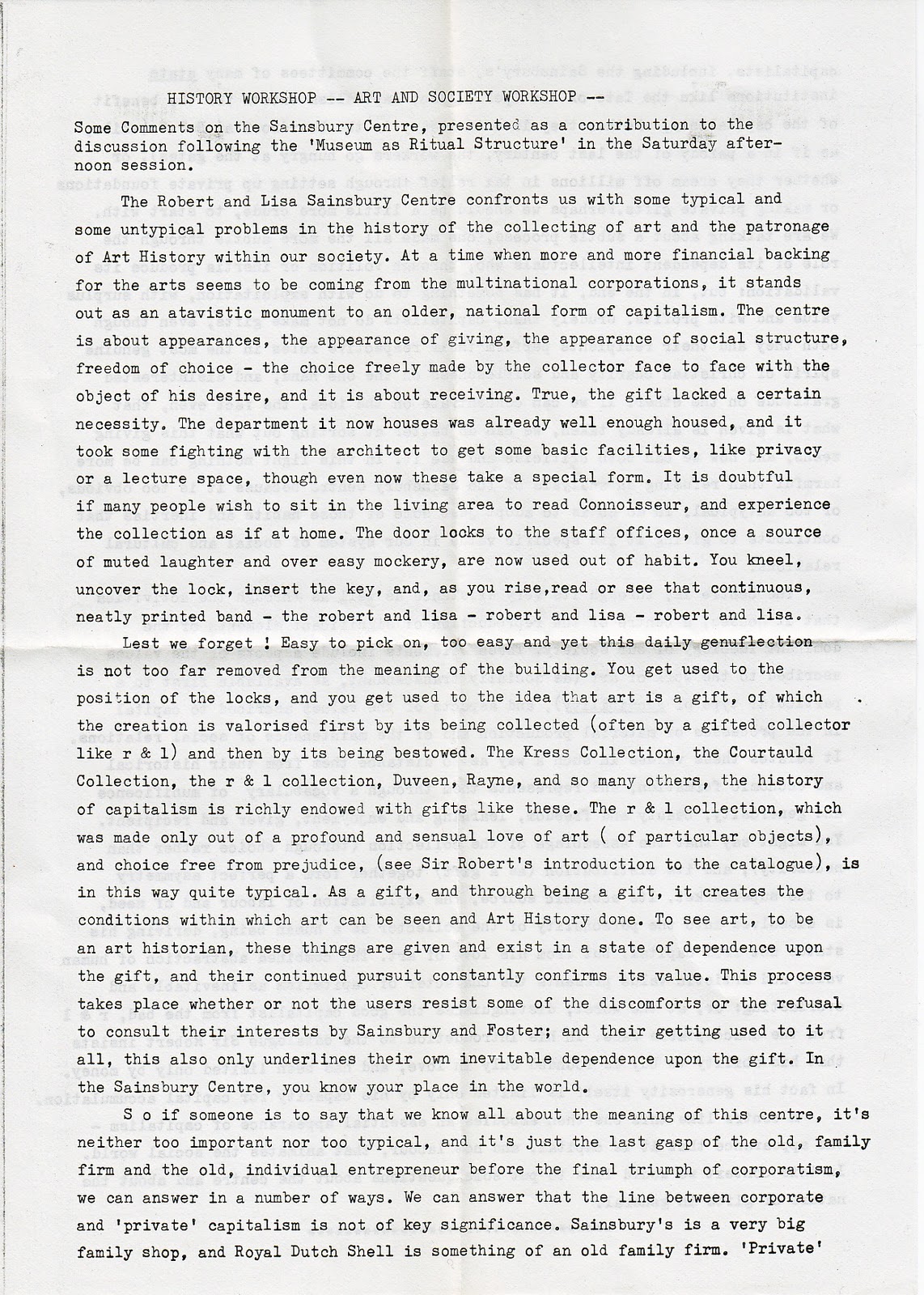
 However here I have put up a leaflet produced for the Art and Society group of History Workshop as a nice flavour of the academic politics of the time - guess the anonymous author from the syntax, if you like:


Thursday, 20 October 2011

I wish I wish I wish in vain ... (Dylan)

With colleagues and students in La Tartine, Paris, on barricade and revolution tracking visit circa 1979, in the context of a history course on European Revolutions at Portsmouth Poly- wonderful, long pre-modular course over three terms, time to think, time to do, days to track the barricades of 1789, 1830, 1848, 1871 - political and psycho geography as historical method. So this is now an allegory of the time for thinking. My head from behind, right hand edge: forgive the sepia, it gives an idea of the tobacco effect of the pre-gentrified Tartine


Below is a part of my pseudo-Atget series that I did while Molly Nesbit was working in Paris on her miraculously good Atget's Seven Albums, not only one of the best books on photography ever written, but one of the finest of the whole so called Social History of Art movement. I did a series on the Hotel de Beauvais in the rue François Miron, when it was still grim and unrestored and tnemented. But I was also doing a series on Parisian gay masculinities and guys on the streets, as well as in mural paintings of religious and military scenes. So in this rather simplistic collage I began a cruising-Atget series, now it would be called queering Atget. By the early 80s this was influenced by the late Nicholas Green, my first PhD student, but maître ès drague gaie, and author of The Spectacle of Nature. Somewhere I have negatives of Beauvais with him rather than this boy imported from the quais, and I will look for them.


Wednesday, 19 October 2011

Self Portrait 1974

More political prints

In the blogs before this I commented on the prudishness of public discourse and the regression of the right to speak, and even though some cartooning, like that of Steve Bell or others makes their target revolting, it rarely calls on a history of revolution to suggest a political solution - like this reaction to the Franco Prussian war of 1870. Captioned with the now rather horrible line of the Marseillaise 'Let an imoure blood slake our fields' - in the post colonial, post Vichy period it is a scandal that it's still there - here it calls for an internationalist solution, the decapitation of ALL the rulers involved:: Bismarck, Wilhelm and Napoléon lll.


These come from hundred of old negative I have of research done in the late 1970s around the Commune of Paris of 1871 and I will start scanning the colour negs soon. The above is a driect quotation from a print of 1792.

Below a nicely witty and direct attack on the French government of Thiers and Favre for its attack on Republican values, easy mix of the political and the sexual in the conventions of academic art forms and satire, so both levels work together.  Remember these prints could end their makers in prison and, outside the great private collections, ironically built as much by aristocrats like the Baron de Vinck as left municipalities in a later period, St Denis, Montreuil, they were systematically destroyed for over two decades after they were made...


Monday, 17 October 2011

!7 October 1961 - 2011 50 years of falshood and cover up

Today is the 50th anniversary of the massacre of hundreds of French Algerians in Paris - demonstrating for the independence of their country from French colonial rule and an end to the brutal repression of their country. Covered up for years by the authorities, the bodies processed out of sight and evidence,  those who were responsible, Prefet  Papon,  were the same who had happily collaborated with and organised the deportation of the Jews to death camps under the Nazi occupation (Bousquet, Touvier) - and then doctored the archives to cover their tracks. Even the 'left' were anxious to keep it quiet. In J-P Rioux's text book on modern France the massacre got half a line as I recall. Indeed the first real exposition of the events and how they were hidden was by the crime writer, Didier Daeninckx in his brilliant novel Meurtres pour mémoire, (1984, translated by Serpent's Tale), and this while Mitterand was cosying up to his old friends - the 'distinguished' administrators who had perpetrated the horror. His publicity on Serpent's Tail states:
His 1984 novel Murder in Memoriam forced the French government to try Nazi collaborators, led to a life of imprisonment for Paul Touvier and made President Mitterrand declare 16 July a day of national reflection on fascism and racism.

Buy it - read it!!!


As I recall, even after Meurtres, it was hard to get cooperation to find documents. There was a bit of my own research that involved putting together figures of Parisian darkness, criminality and the great and the good between the 1930s and 1950s. I was trying investigate the pre-war fascistic prefet Chiappe (he died in a plane crash up to some dirty business for Vichy in 1940) and associate him with the post war 'heritage' of Papon et al, and the librarians at the Bibliothèque Historique de la Ville de Paris were utterly obstructive, claiming that, if my interest was music hall, they had no reason to get me out dossiers on the Police! Daeninckx's novel, as well as being a real thriller, was an immense support.

The first really public coverage I recall was a section of the Pompidou Centre exhibition Face à l'Histoire of 1996 but by then the barrage of silence was broken.

Read Kristin Ross, Fast Cars, Clean Bodies - Decolonization and the Reordering of French Culture, 1995


However it's worth recalling that the City of Light has long been, second to none, the City of Bloodbaths.

Prudish times

The habit and indeed right to be free of standing in awe of faith as such, whether religious, scientific, political or whatever, and the command to respect feelings as such, all of which are a part of new, reactionary ideologies are a more or less dreadful sign of our times, so here is a god old satire of the Paris commune by the great draughtsman and militant Pilotell, who came to London as an exile in 1871, where he prepared the album of his work from which this is drawn:  Note well that it includes revolutionary deities such as the Supreme Being of the 1789 Revolution.

Decidedly, if god existed, it would be necessary to execute him:

Tuesday, 9 August 2011

More archive pics


Invalides taken in 1959, pre Malraux's cleaning up Paris, no scraping or gilding,  so a bit of photoshop to help out in the sky, Ektachrome stock, Rolleicord 5B


1950s wallpaper and shadow of drying rack, mother's elbow, Salford, c1960


Canal St Martin, c 1980, probably Rollei 35TE


Butte aux Cailles, Rue Samson, c 1982


In return: London today; a dithyramb.

Accurate scholarship can
Unearth the whole offence
From Luther until now
That has driven a culture mad
Find what occurred at Linz,
What huge imago made
A psychopathic god:
I and the public know
What all schoolchildren learn, 
Those to whom evil is done
Do evil in return.

Auden, September 1, 1939.

The evil that is done is the grotesque transformation of London into the home-ground for a mega-wealthy, semi-criminal class of robber barons and their ostentatious palaces like Number 1 Hyde park, boasting of this transformation as in Evan Davies' recent TV programmes on the economy, in the Evening Standard and elsewhere. The evil that is done is the cuts that announce the abandonment of whole swathes of the population so that this glory can expand its aureole as if a sign of progress. It is the farce of robber-barony revealed in the whole News International affair, Andy Hayman taking offence as the suggestion he took money from NI when two months after leaving the police he was on their payroll. It is the prattling of the racist, discredited police establishment about how well it has dealt with its own shortcomings of corruption and unremitting racism, and it is the vain and venal politics of Blair, Brown and Blunkett with their prattling about conscience when their judgement was never more than the execution of the requirements of robber-barony, finance, warmongering and so forth. It is the cretinous detachment of the little boys, badly educated scum now running parliament and their sucking up to any super right ideology that they can sniff out ... All of this is just to touch the daily evil that is done.

What is done in return is only evil in one respect: in that it cannot, in effect, set right what has been done already. So the riotous Londoners are not the new evil, but the difficulty of a new good in a situation in which the greatest good known in our public politics is to settle with one's own venality.

Riotous London offers a scene in which, at least, perhaps, this can be seen more clearly and where the political might be newly made - it is a politics of our time, even though it is not a theory. That is what politicians will now try to cover up with their moralising.


Some of the cranes are on a building that stopped going up on December 28 2008, a suitable hint at ruin in the now time of the capitalism of enforced debt. The rainbow is sheer conicidence.